

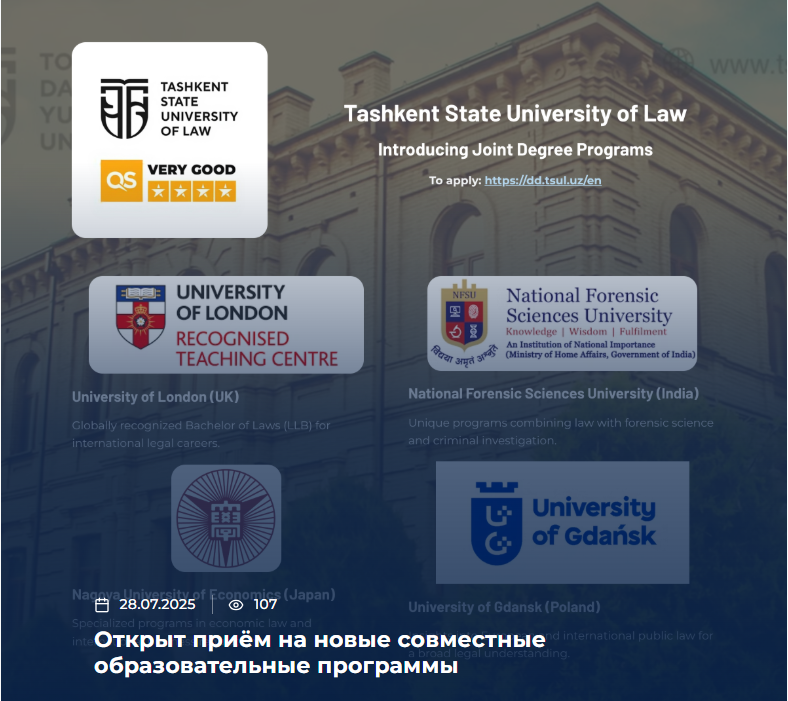
Joint educational programs
In the context of globalization and the rapid transformation of higher education systems, joint educational programs have become one of the most effective instruments for improving academic quality, strengthening institutional cooperation, and integrating national universities into the international educational environment. A joint educational program generally refers to an academic program developed and implemented collaboratively by two or more univerisities from different countries on the basis of a bilateral agreement. Such programs allow students to study within harmonized curriculum, benefit from shared academic resources, and in many cases obtain degees or diplomas recognized by both univerisities.
In contast to traditional exchange programs, joint educational programs are characterized by long-term institutional cooperation, coordinated academic standards, harmonized curricula, and mutual recognition of credits and learning outcomes. They usually involve shared teaching responsibilities, mobility of students and faculty members, collaborative research activities, and practical training components. In legal education, such programs play a particularly important role because they expose students to comparative legal systems, international legal standards, and cross-border professional practices.
One of the most distinctive features of joint educational programs is their interdisciplinary and practice-oriented approach. Modern legal education increasingly requires not only theoretical knowledge but also practical competencies, legal reasoning, communication skills, and the ability to operate within international legal environments. Cooperation with foreign universities provide access to diverse teaching methodologies, advanced digital educational technologies, and international academic culture. At the institutional level, such partnership also promote modernization of curricula, quality assurance, governance, and research standards.
The role of joint educational programs in promoting best practices
Joint educational programs serve as an important bridge for adopting advanced international educational experiences and strengthening national human capital. In many developing legal systems, challenges remain regarding academic modernization, practical training, internationalization of curricula, and integration of legal education with research and professional practice. Joint educational programs provide an effective solution to many of these issues.
Firstly, they facilitate the transfer of academic knowledge and institutional experience from internationally recognized universities to local institutions. This process allows countries to adopt best practices in curriculum development, quality assurance, student assessment, digital learning systems, and legal research methodologies.
Secondly, such programs help prepare competitive legal professionals capable of functioning in both domestic and international legal environments. In an era of increasing economic integration and transnational business activities, legal practitioners must possess comparative legal knowledge and understand international standards of corporate governance, dispute resolution, competition law, investment law, and digital regulation. Joint educational programs significantly contribute to developing such competencies.
Thirdly, joint educational programs strengthen the connection between legal education and practice. Through clinical legal education, internships, dual education principles, and cooperation with legal practitioners, students acquire practical skills necessary for modern legal professions. This aspect is particularly important for nations where traditional legal education has historically been more theory-oriented.
Another important contribution of joint educational programs is their role in enhancing academic reputation and international visibility of national universities. Participation in international educational partnerships positively influences institutional rankings, publication activities, academic mobility, and research cooperation. Consequently, such programs contribute not only to student development but also to the strategic advancement of universities themselves.
Legal education reforms in Uzbekistan and the strategic role of joint educational programs at TSUL
The Republic of Uzbekistan has recently initiated large-scale reforms aimed at modernizing legal education and strengthening the connection between legal science, education, and professional practice. In this regard, the Presidential Decree of the Republic of Uzbekistan “On Measures for Further Reforming Legal Education and Legal Science in the Republic of Uzbekistan” has once again emphasized the strategic importance of these reforms.
The Decree emphasizes that improving the quality of education is the only correct path toward the development of New Uzbekistan and establishes several strategic objectives for legal education reform. Among the primary goals are the introduction of practice-oriented teaching methods, implementation of clinical and dual education principles, strengthening the integration of education, research, and practice, improving academic governance, and enhancing quality control mechanisms within legal education institutions.
A particularly important strategic objective outlined in the Decree is ensuring that Tashkent State University of Law (TSUL) enters the top 1000 universities in the field of law according to the prestigious Quacquarelli Symonds (QS) international rankings by 2030. Achieving this objective requires not only institutional reforms but also active international cooperation and integration into the global academic environment.
Within this framework, joint educational programs occupy a central role in TSUL’s development strategy. These programs enable the university to introduce international teaching standards, strengthen English-medium legal education, improve academic mobility, and expand comparative legal studies. They also contribute to creating a new generation of legal professionals capable of addressing complex legal issues in both national and international contexts.
Moreover, joint educational programs support the implementation of the “education–research–practice” integration model promoted by the Presidential Decree. Through collaborative curricula, international faculty involvement, practical training opportunities, and joint academic initiatives, TSUL is gradually transforming into a modern research-oriented law university aligned with international standards.
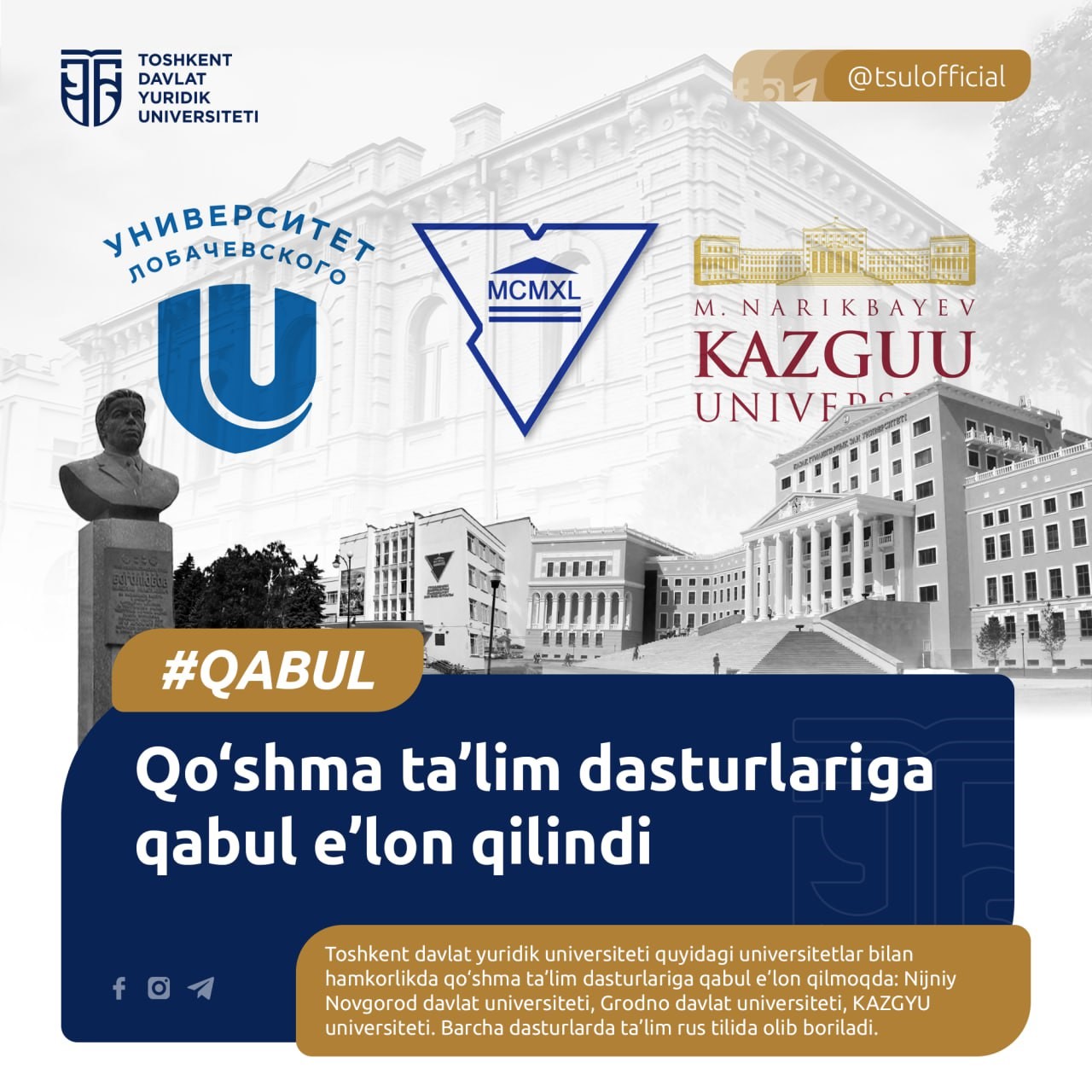
The successful cooperation between TSUL and MNU University
One of the most successful examples of international academic cooperation in legal education in Central Asia is the long-standing partnership between TSUL and Maqsut Narikbayev University. This cooperation has been developing successfully for more than six years and has become an important model of regional academic integration.
Maqsut Narikbayev University is widely recognized as one of the leading institutions for legal education in Central Asia. The university ranks first nationally in both the International Law and Jurisprudence Programs according to Atameken National Chamber of Entepreneurs ranking.
The MNU has also gained international recognition through its outstanding participation in prestigious moot court competitions, particularly the Philip C. Jessup International Law Moot Court Competition, where its students have consistently demonstrated exceptional advocacy, legal reasoning, and legal writing skills at both national and international levels.
These acomplishments, together with an employment rate exceeding 95%, reflect the university’s strong commitment to academic excellence, practice-oriented legal education, and the preparation of highly qualified and globally competitive legal professionals.
The joint educational program established between the two universities at the bachelor’s level has demonstrated significant academic and institutional advantages. The program is based on harmonized curricula, coordinated academic standards, and the mutual recognition of learning outcomes, allowing students to study within an integrated educational framework. Participants benefit from instruction delivered by international faculty members, opportunities for academic mobility, involvement in joint academic and research initiatives, and exposure to diverse legal traditions and approaches.
In the field of legal education, such cooperation is particularly important, as it strengthens students’ comparative understanding of legal systems within the Eurasian region and enhances their ability to operate in an increasingly globalized professional environment. The program also contributes to the development of analytical, research, advocacy, and practical legal skills necessary for future legal professionals engaged in international, regional, and cross-border legal practice.
Importantly, this cooperation extends beyond formal academic exchange. Over the years, the partnership has contributed to institutional trust, collaborative academic activities, exchange of best educational practices, and enhancement of educational quality standards. The experience accumulated through this partnership demonstrates how regional cooperation among leading law universities can significantly contribute to strengthening legal education in both countries.
In addition, the program has already produced tangible academic and professional results. Each year, more than 30 highly qualified legal specialists successfully graduate from the joint educational program, possessing extensive knowledge of the legal systems, legislation, and legal practice of both Uzbekistan and Kazakhstan. Such graduates are capable of operating effectively within transnational legal environments and contribute significantly to the development of legal practice in the region.
Furthermore, the TSUL–MNU partnership illustrates the practical implementation of the goals outlined in Uzbekistan’s and Kazakhstan’s legal education reforms. It reflects the transition toward practice-oriented education, internationalization of academic processes, and integration of education with professional development.
In conclusion, the experience of cooperation between TSUL and MNU University demonstrates that joint educational programs are not merely academic projects but strategic instruments for institutional modernization, development of competitive legal professionals, and integration into the global educational and legal community. For Uzbekistan such partnerships represent an effective pathway toward achieving international educational standards while simultaneously addressing national development priorities.
Authors
Doniyor Abduazizov
Head of the Department of Double Degree Programs
Tashkent State University of Law
Dr.Shakhzoda Tuychiyeva
Associate Professor of Private Internation Law Department
Tashkent State University of Law
Photo: tsul.uz